Organization of treatment and rehabilitation in Germany.
Complete medical support.
Complete medical support.





+49 176 17917001
All departments

Lung cancer is the second most common type of oncopathology, which is slightly behind breast cancer in frequency of occurrence. According to world statistics, in 2020, lung cancer accounted for 11.4% of all types of newly diagnosed malignant tumors — more than 2 million new cases per year. At the same time, lung cancer remains the leading cause of death: of 10 million cancer patients who died in 2020, 18% had this type of oncopathology.
Late detection of lung cancer and insufficient treatment options for this disease in many developing countries lead to negative prognoses for patients. The overall 5-year survival rate for cancer patients is 10-20% after diagnosis. At the same time, diagnosis at the first stage increases the chances of successful lung cancer treatment to 73-95%, which once again emphasizes the importance of timely comprehensive examination.
The insidiousness of lung cancer lies in the fact that the disease does not manifest itself for a long time, and significant symptoms appear already at an advanced stage. According to the localization of the tumor, 2 types of cancer are distinguished — central and peripheral, which determines the clinical picture of the disease. Also, the neoplasm can be small cell and non-small cell, but this does not have a significant effect on the symptoms.
In central cancer, the neoplasm is located in the large bronchi, so it more quickly causes clinical manifestations, such as:
Peripheral lung cancer is located in the thickness of the organ, where there are no pain receptors, so the tumor grows asymptomatically. The typical clinical picture of the disease occurs with a large size of the neoplasm and involvement of neighboring organs in the process. In this case, patients complain of pain in the affected half of the chest, coughing up blood, pain when breathing.
In addition to local signs, general symptoms of lung cancer are distinguished, which are a reflection of the nonspecific process of growth and development of a malignant tumor. Such manifestations include weakness, decreased appetite, headaches, unexplained weight loss. In the late stages of the disease, cancer cachexia may occur — exhaustion, a sharp decrease in the amount of adipose tissue and muscle mass.
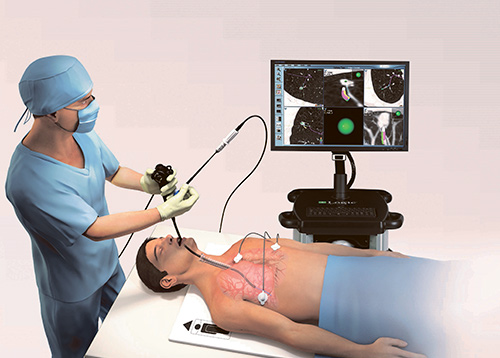
For a detailed examination of the state of the bronchopulmonary system, modern diagnostic methods are used in German clinics:
The diagnostic program may differ from the standard one, taking into account the peculiarities of the course of the disease in a particular patient. Representatives of the selected German clinic will tell you more about the necessary tests and studies after studying the medical history.
Treatment of lung cancer is determined by the stage of the disease, the localization of the tumor and its molecular genetic characteristics, as well as the general state of the patient's health, which affects the possibility of using radical and/or aggressive therapy methods. For each cancer patient in a German clinic, an individual plan is developed, which includes traditional surgical and chemoradiological methods, as well as the latest treatment approaches that show good results.

Surgical treatment is the main method of treating lung cancer. In 10-20% of cases, a radical operation is performed to remove the entire array of tumor cells, and the remaining patients undergo the maximum possible resection of the neoplasm. Methods of surgical treatment in German clinics:
The peculiarity of surgical operations in Germany is the use of modern minimally invasive intervention methods, if the size and localization of the tumor allow it. Doctors of German clinics actively use endoscopic and thoracoscopic instruments, with which surgeons remove small neoplasms without an incision in the chest wall. Such treatment of lung cancer shortens the recovery period and improves the functional result.
The use of cytostatics — drugs that destroy tumor cells — is an important direction in the treatment of lung cancer. When prescribing chemotherapy in German clinics, 2 main methods are used:
There are many chemotherapy regimens that are selected taking into account the cytological and molecular genetic characteristics of the tumor.
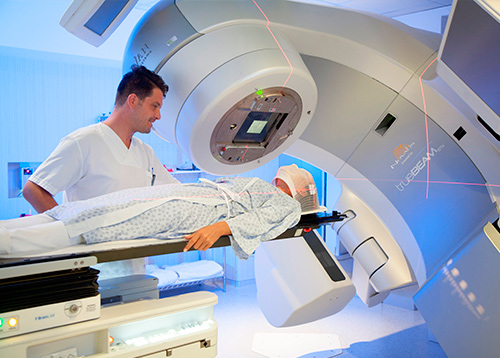
Radiation therapy is a traditional method of cancer treatment that allows reducing the volume of tumor cells. It is prescribed at stages 1-2 of the disease as an independent therapy when it is impossible to perform an operation for medical reasons, and is also used as an auxiliary method in the postoperative period. External beam radiation therapy reduces the risk of lung cancer recurrence, increases the life expectancy of patients. As part of palliative care, radiation can reduce pain, pulmonary bleeding and other symptoms in cancer patients. To increase the effectiveness of treatment, German clinics use a combination of chemotherapy and radiation therapy.
In German clinics today, classical radiation therapy has been replaced by targeted radiation therapy, which provides a local effect of high doses of radiation on tumor cells. This approach allows reducing the irradiation time to 3 days (in standard cases), and reducing the duration of one session by 4 times.
In large clinics in Germany, the latest technique that replaces traditional radiation therapy is already available — the CyberKnife. The equipment is used for radiosurgical removal of lung neoplasms up to 10 cm in size, as a safer and more effective alternative to classical surgery. CyberKnife is also used for the maximum possible removal of lung metastases that cannot be dealt with using traditional surgery.
Targeted drugs act only on tumor cells, since they interact with specific receptors, and do not damage healthy body tissues. Treatment of lung cancer in a German clinic involves personalized selection of these drugs, taking into account the genetic characteristics of the neoplasm. Targeted drugs are an effective replacement for classical chemotherapy.
German clinics can offer patients unique immunotherapy courses, which is a method of activating the body's own immune system to fight cancer cells. This cancer treatment is well tolerated by most cancer patients and is used at different stages of lung tumor development.
To date, more than 3000 patients have already received unique lung cancer treatment using immunotherapy in German clinics, which helped stop the progression of oncopathology, reduce tumor volume and restore a relatively high quality of life to people. However, immunotherapy cannot be used for all cases of lung cancer, so before its prescription, the patient undergoes an extended examination.

Protons have the unique ability to penetrate through
healthy tissues and target the tumor focus, so they are much safer than radiation therapy. Proton treatment of lung cancer in a German clinic allows directing up to 80% of radiation precisely to the malignant neoplasm. With this method, the load on the body is reduced by 65%, the risk of heart damage is eliminated, and the number of complications is reduced.
Treatment of lung cancer with modern methods has achieved good survival rates for these patients in Germany, compared to other countries. For women under 60 years old, the 5-year survival rate is 23.7%, for men of the same age group — 18.5%. Among elderly patients, the results
are expectedly lower (10.6% and 8.4% respectively). These indicators are among the best in Europe, so undergoing therapy in a German clinic is a real chance for complete recovery or significant life extension for a lung cancer patient.
The cost of lung cancer treatment depends on the stage of oncopathology, the presence of distant metastases and complications, and the general condition of the patient. The price is affected by the volume of medical care, the need to use expensive innovative methods, and the length of stay in the clinic. The exact cost is calculated individually for each patient after studying their medical records and selecting the optimal treatment regimen.
On average, prices for lung cancer diagnosis in German clinics start from €2250. Surgical treatment will cost €5000-22000 depending on the scope of the operation and the method of its performance. Chemotherapy prices start from €2260, and radiation therapy — from €15000.
Many large clinics in Germany that have oncology departments accept foreign patients for lung cancer treatment. The best results are shown by clinics such as: Helios Berlin-Buch, Asklepios Barmbek, Helios Krefeld, Bremen-Mitte, Nordwest and others.
High-precision research methods

Comprehensive approach to treatment
New surgical techniques

Low complication rate

Treatment of complex cases
High therapy effectiveness
High-precision research methods
Comprehensive approach to treatment
New surgical techniques
Low complication rate
Treatment of complex cases
High therapy effectiveness
 +49 176 17917001
Or send us a message: