Organization of treatment and rehabilitation in Germany.
Complete medical support.
Complete medical support.





+49 176 17917001
All departments
Limb fractures are among the most common injuries — over 800,000 fractures are registered annually in Germany. Modern German traumatology follows AO Foundation principles — the world standard for fracture treatment. Minimally invasive osteosynthesis, navigation systems, and innovative MIBRAR® therapy for osteogenesis stimulation ensure optimal outcomes. For delayed union and nonunion, MIBRAR® becomes the method of choice.
Fractures are classified by skin integrity (closed vs. open/Gustilo I–III), fracture line (transverse, oblique, spiral, comminuted, segmental), displacement (none vs. length/width/angulation/rotation), location (diaphyseal, metaphyseal, epiphyseal, intra-articular), and cause (traumatic vs. pathological from osteoporosis, tumors, or osteomyelitis).
Radiography in two projections capturing two adjacent joints provides the baseline assessment. CT with 3D reconstruction is essential for intra-articular and complex comminuted fractures and surgical planning. MRI detects stress fractures (invisible on X-ray), evaluates soft tissues, and identifies osteonecrosis. CT angiography is used when vascular injury is suspected. Laboratory tests for pathological fractures include calcium, vitamin D, alkaline phosphatase, bone metabolism markers, and tumor markers.
Indicated for stable fractures without or with minimal acceptable displacement. Modern lightweight polymer casts replace heavy plaster. Functional orthoses allow early joint movement. Skeletal traction temporarily stabilizes femoral fractures before surgery. Densitometry plus osteoporosis treatment is mandatory for osteoporotic fractures.
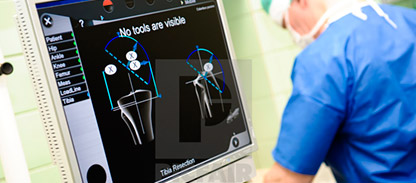
German traumatologists follow AO/ASIF principles — anatomic reduction, stable fixation, blood supply preservation, and early mobilization. Intramedullary nailing introduces a titanium nail into the medullary canal through a small incision — the method of choice for diaphyseal femur, tibia, and humerus fractures enabling early weight bearing. Angular stability plates (LCP) fix metaphyseal and periarticular fractures, with MIPO technique (minimally invasive plate osteosynthesis) through two small incisions. Cannulated screws fix simple fractures (femoral neck, scaphoid, malleoli). External fixation provides temporary or definitive stabilization for open, polytrauma, and infected fractures. Arthroscopically-assisted osteosynthesis controls reduction for intra-articular fractures via camera.
Fractures (Frakturen) are included in the indications for MIBRAR® technology, particularly effective for delayed union (when fracture fails to heal in expected timeframes — ARC stimulates osteogenesis as mesenchymal stem cells differentiate into osteoblasts), nonunion (pseudarthrosis) (MIBRAR® as an alternative to repeat surgery with bone grafting), fresh fractures (intraoperative ARC transplantation accelerates healing and reduces nonunion risk), and osteoporotic fractures (bone formation stimulation in reduced density conditions). The MIBRAR® microperforator performs targeted microperforations in the fracture zone, then ARC is transplanted under fluoroscopic or Sono Control Arm™ guidance. Outpatient, without anesthesia.
Delayed union means the fracture hasn't healed in expected timeframes (4–6 months for long bones). Nonunion (pseudarthrosis) indicates healing has stopped (>6 months) requiring active treatment. Osteomyelitis (bone infection) occurs especially with open fractures. Osteonecrosis from disrupted blood supply affects the femoral neck and scaphoid. Post-traumatic arthrosis follows intra-articular fractures. Compartment syndrome from elevated muscle compartment pressure requires emergency fasciotomy.
Early mobilization from the first post-operative days, exercise therapy for range of motion restoration and muscle strengthening, physiotherapy with electrostimulation, ultrasound and magnetotherapy, follow-up radiographs at 6, 12 weeks and 6 months, and hardware removal at 12–18 months (when indicated) constitute the recovery program.
| Service | Price, € | Note |
|---|---|---|
| Diagnostics (CT + exam) | 2,000–4,000 | 1 day |
| Osteosynthesis (plate or nail) | 8,000–20,000 | 3–7 days inpatient |
| MIBRAR® therapy (delayed union) | on request | outpatient |
| Hip replacement (femoral neck fracture) | 15,000–25,000 | 5–10 days inpatient |
All treatment prices in Germany.
Germany offers AO Foundation-standard minimally invasive osteosynthesis, MIBRAR® therapy for healing stimulation and nonunion treatment, navigated surgery for intra-articular fractures, comprehensive osteoporosis treatment preventing repeat fractures, a complete rehabilitation cycle at world-class clinics, and multilingual assistance. Proper fracture treatment ensures full recovery — contact us for treatment planning in Germany.



 +49 176 17917001
Or send us a message: